


CVD Diamond vs Moissanite – Complete Comparison Guide (2026)

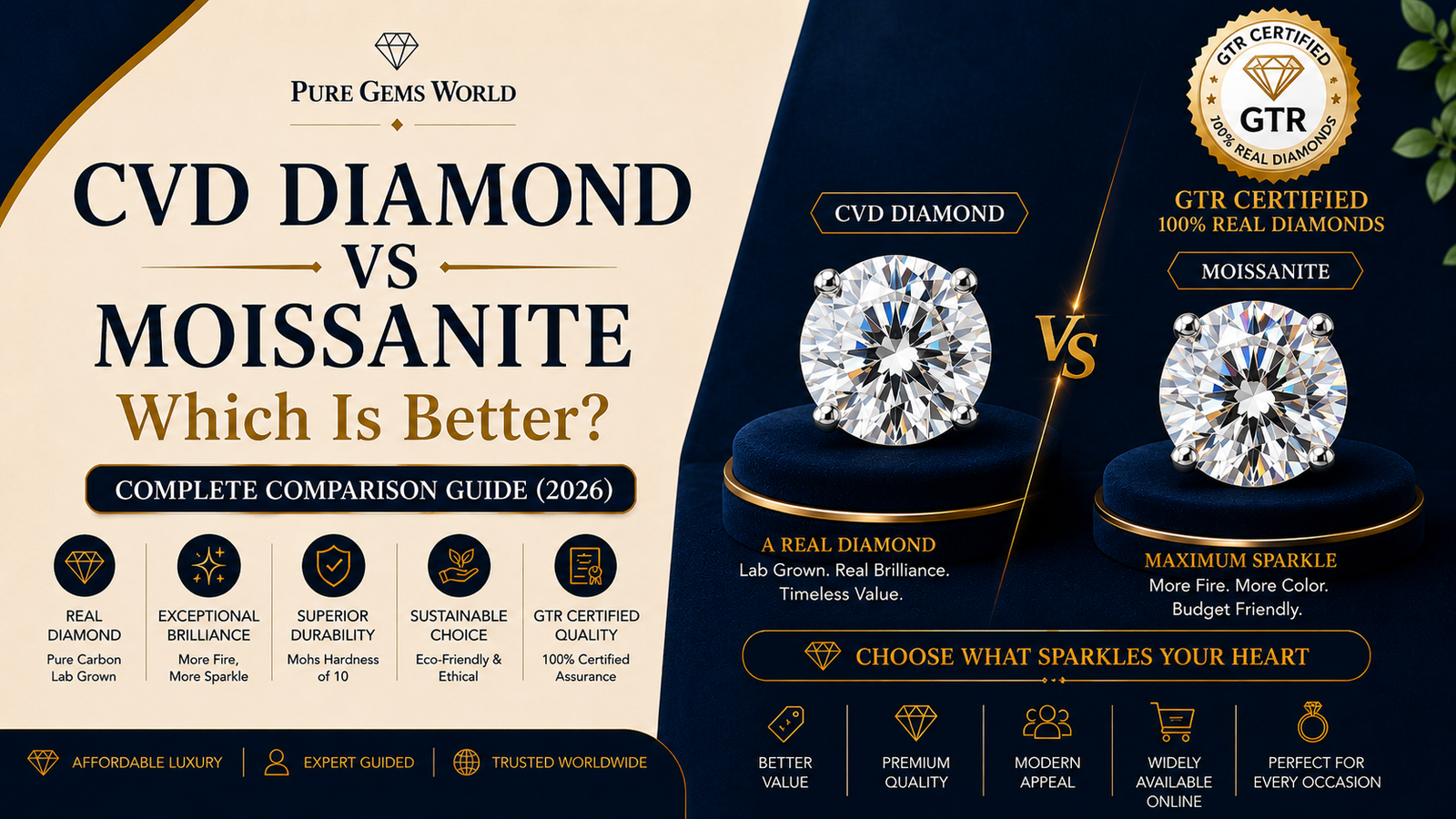
Imagine standing in a jewelry showroom with two stunning gemstones placed side by side. Both sparkle brilliantly, both appear nearly identical to the naked eye, and both cost significantly less than a natural diamond. One is a CVD Diamond, while the other is Moissanite. Which one deserves your investment?
If you’ve been searching for CVD Diamond vs Moissanite, you’re not alone. Thousands of buyers compare these two gemstones before purchasing an engagement ring, wedding band, pendant, earrings, or custom jewelry. Although they may look similar at first glance, they are fundamentally different in composition, durability, brilliance, value, and long-term ownership.
Choosing the wrong stone can lead to disappointment, especially if you expect it to perform like a real diamond. On the other hand, selecting the right gemstone can give you exceptional beauty, outstanding durability, and excellent value for years to come.
In this comprehensive guide, we’ll compare every important aspect of CVD Diamonds and Moissanite—from appearance and sparkle to price, hardness, maintenance, certification, resale value, and overall buying experience—so you can confidently choose the gemstone that best suits your lifestyle and budget.
What is a CVD Diamond?
A CVD (Chemical Vapor Deposition) Diamond is a genuine diamond created inside a highly controlled laboratory using advanced scientific technology. Rather than being mined from the earth, it is grown atom by atom from carbon, resulting in a crystal that is chemically, physically, and optically identical to a natural diamond.
The only difference between a natural diamond and a CVD diamond is their origin.
Natural diamonds form deep within the Earth over billions of years under extreme heat and pressure. CVD diamonds recreate those conditions in a laboratory within a few weeks, producing a gemstone that possesses the same crystal structure, hardness, brilliance, and durability.
Because they are real diamonds, CVD diamonds receive certifications from reputable gemological laboratories such as IGI and GIA, just like natural diamonds.
Key Characteristics of CVD Diamonds
- Made from pure carbon
- Real diamond composition
- Hardness of 10 on the Mohs scale
- Exceptional brilliance and fire
- Available in various cuts, colors, and clarities
- Suitable for engagement rings and fine jewelry
- Environmentally responsible alternative to mined diamonds
What is Moissanite?
Moissanite is a completely different gemstone. While it closely resembles a diamond in appearance, it is made from silicon carbide instead of carbon.
Natural moissanite is extremely rare, so nearly all moissanite gemstones available today are laboratory-created.
Unlike CVD diamonds, moissanite is not a diamond. It has its own unique optical properties, which produce more colorful flashes of light than diamonds. Some people love this dramatic sparkle, while others prefer the more natural brilliance of a real diamond.
Moissanite has become increasingly popular because it offers impressive beauty at a much lower price point.
Key Characteristics of Moissanite
- Made from silicon carbide
- Not a real diamond
- Hardness of 9.25 on the Mohs scale
- Extremely high fire and colorful sparkle
- Affordable alternative to diamonds
- Excellent durability for everyday wear
Why This Comparison Matters
Buying fine jewelry is often an emotional and financial decision. Whether you’re shopping for an engagement ring, anniversary gift, or everyday jewelry, understanding the difference between these gemstones helps you make a purchase you’ll be happy with for years.
Some buyers prioritize authenticity and long-term value, while others focus on affordability and visual appeal. Knowing what each gemstone offers ensures that your expectations match reality.
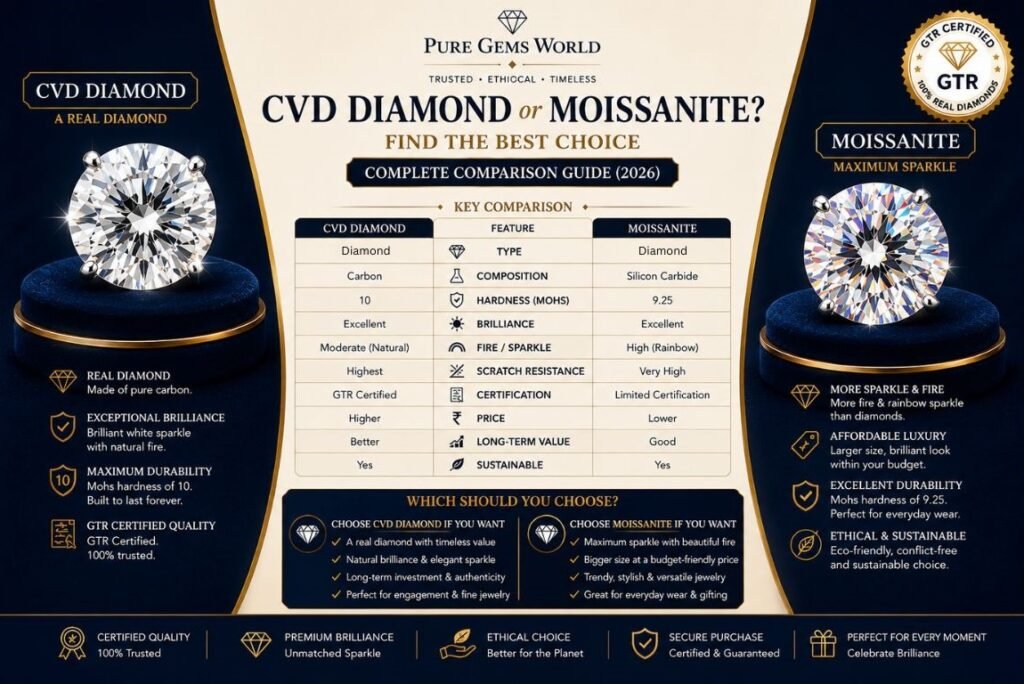
CVD Diamond vs Moissanite: Quick Comparison
| Feature | CVD Diamond | Moissanite |
|---|---|---|
| Composition | Pure Carbon | Silicon Carbide |
| Is It a Real Diamond? | Yes | No |
| Mohs Hardness | 10 | 9.25 |
| Brilliance | Natural Diamond Brilliance | Higher Rainbow Fire |
| Sparkle | White Light | Colorful Rainbow Sparkle |
| Certification | IGI, GIA | Limited Certification |
| Durability | Excellent | Very Good |
| Scratch Resistance | Highest | Very High |
| Price | Higher | Lower |
| Long-Term Value | Better | Moderate |
Appearance: Which Looks More Like a Natural Diamond?
Appearance is one of the biggest deciding factors for jewelry buyers.
At first glance, both gemstones can appear nearly identical. However, their optical behavior differs significantly.
CVD Diamond Appearance
Since a CVD diamond is chemically identical to a natural diamond, it exhibits the same balance of brilliance, fire, and scintillation.
Its sparkle appears crisp, elegant, and refined.
The white flashes of light create a luxurious appearance that closely resembles mined diamonds.
Even professional jewelers often require specialized equipment to distinguish a certified CVD diamond from a natural diamond.
Moissanite Appearance
Moissanite is famous for its intense sparkle.
It has a much higher refractive index than diamond, causing it to reflect more colorful flashes of rainbow light.
Under bright lighting, moissanite often appears more “disco-like,” producing vibrant flashes of red, blue, green, and yellow.
While many buyers love this dramatic sparkle, others feel it looks less natural compared to a diamond.
Sparkle Comparison
Understanding sparkle requires knowing three important terms:
Brilliance
Brilliance refers to the white light reflected from the gemstone.
CVD diamonds provide balanced brilliance that closely matches natural diamonds.
Fire
Fire describes colorful flashes of light.
Moissanite displays nearly twice as much fire as a diamond.
This creates vibrant rainbow reflections, especially under LED lighting.
Scintillation
Scintillation is the sparkle seen when the gemstone moves.
Both stones perform well, but CVD diamonds offer a more sophisticated and natural sparkle pattern.
Hardness and Durability
Jewelry worn every day should withstand years of regular use.
Here’s where both gemstones perform exceptionally well.
CVD Diamond
Mohs Hardness: 10
Diamonds are the hardest naturally occurring material known.
They resist scratches better than any other gemstone.
This makes them ideal for engagement rings and heirloom jewelry.
Moissanite
Mohs Hardness: 9.25
Although slightly softer than diamond, moissanite remains one of the hardest gemstones available.
It easily withstands everyday wear and resists scratching better than sapphires, rubies, emeralds, and most other gemstones.
Which One Lasts Longer?
Both gemstones can last a lifetime with proper care.
However, CVD diamonds maintain a slight advantage because of their unmatched hardness and resistance to wear.
If longevity is your primary concern, CVD diamonds remain the benchmark for durability.
Price Comparison
One of the biggest reasons buyers compare these gemstones is cost.
CVD Diamond Pricing
CVD diamonds are significantly more affordable than mined diamonds while offering identical physical properties.
Depending on the size and quality, they generally cost 60–90% less than comparable natural diamonds.
Prices increase based on:
- Carat weight
- Cut quality
- Color grade
- Clarity grade
- Certification
Moissanite Pricing
Moissanite is even more budget-friendly.
It typically costs substantially less than a CVD diamond of similar size.
This makes it attractive for buyers seeking maximum visual impact at the lowest possible price.
However, lower cost also reflects the fact that moissanite is a different gemstone rather than a diamond.
Value for Money
Choosing the better value depends on your priorities.
If you want:
- A real diamond
- Better resale perception
- Higher authenticity
- Premium jewelry experience
- Certified gemstone
A CVD diamond delivers outstanding long-term value.
If your primary goal is:
- Lowest price
- Maximum sparkle
- Large stone within budget
Moissanite offers exceptional affordability.
Ethical and Environmental Considerations
Modern consumers increasingly care about sustainability.
Both CVD diamonds and moissanite are laboratory-created, meaning they avoid the environmental impact associated with traditional diamond mining.
Benefits include:
- Reduced land disruption
- Lower carbon footprint
- No large-scale mining operations
- Responsible sourcing
- Conflict-free origin
For environmentally conscious buyers, both options represent ethical alternatives to mined diamonds.
Certification and Authenticity
One major advantage of CVD diamonds is professional certification.
Most high-quality CVD diamonds are graded by internationally recognized laboratories such as IGI or GIA. These reports evaluate:
- Carat weight
- Cut
- Color
- Clarity
- Measurements
- Polish
- Symmetry
- Fluorescence
Which is Better for Engagement Rings?
An engagement ring is more than just a piece of jewelry—it’s a symbol of love, commitment, and a lifelong promise. Because it’s worn daily, the center stone should be durable, beautiful, and capable of retaining its brilliance over time.
Choose a CVD Diamond If:
- You want a real diamond with the same chemical, physical, and optical properties as a mined diamond.
- You prefer a natural-looking sparkle rather than colorful rainbow flashes.
- You value professional certification such as IGI or GIA.
- You want a timeless gemstone that closely matches traditional diamond jewelry.
- You’re looking for better long-term value and prestige.
Choose Moissanite If:
- You have a limited budget.
- You prefer a larger gemstone for the same price.
- You enjoy intense rainbow sparkle.
- You don’t mind owning a gemstone that isn’t a diamond.
For most engagement ring buyers, a CVD Diamond offers the closest experience to owning a natural diamond while remaining significantly more affordable.
CVD Diamond vs Moissanite: Pros and Cons
CVD Diamond Pros
- Real diamond made from pure carbon
- Identical to a natural diamond
- Exceptional durability (Mohs 10)
- Elegant white brilliance
- IGI and GIA certification available
- Excellent choice for fine jewelry
- Better long-term value
- Suitable for heirloom jewelry
Cons
- Higher price than Moissanite
- Slightly smaller size for the same budget
Moissanite Pros
- Very affordable
- Outstanding sparkle
- Highly durable
- Eco-friendly
- Available in larger sizes
- Excellent for fashion jewelry
Cons
- Not a real diamond
- Rainbow sparkle may appear overly flashy
- Lower long-term market perception
- Limited certification compared to diamonds
Step-by-Step Buying Guide
Buying the right gemstone becomes much easier when you follow a structured approach.
Step 1: Decide Your Budget
Determine how much you’re comfortable spending before exploring options.
If your budget allows, a CVD Diamond offers better long-term satisfaction. If you’re looking for maximum size at the lowest price, Moissanite is a practical choice.
Step 2: Define Your Purpose
Ask yourself why you’re buying the jewelry.
- Engagement Ring
- Wedding Ring
- Anniversary Gift
- Pendant
- Earrings
- Daily Wear
- Investment in Fine Jewelry
The intended use often influences the ideal gemstone.
Step 3: Compare Sparkle
If you appreciate elegant white brilliance similar to natural diamonds, choose a CVD Diamond.
If you love colorful flashes and dramatic sparkle, Moissanite may appeal more.
Step 4: Check Certification
Always purchase certified jewelry.
For CVD Diamonds, look for IGI or GIA certification.
Certification ensures transparency regarding cut, clarity, color, and carat weight.
Step 5: Buy from a Trusted Jeweler
Choose a reputable seller that provides:
- Certified gemstones
- Transparent pricing
- Return policy
- Exchange options
- Customer support
- Authenticity guarantee
Common Myths About CVD Diamonds and Moissanite
Myth 1: CVD Diamonds Are Fake
Truth: CVD Diamonds are real diamonds. Their only difference from mined diamonds is their origin.
Myth 2: Moissanite is a Diamond
Truth: Moissanite is an entirely different gemstone made from silicon carbide.
Myth 3: Nobody Can Tell the Difference
Truth: To the naked eye, both can appear similar. However, trained gemologists use specialized equipment to distinguish them.
Myth 4: Lab-Grown Diamonds Don’t Last
Truth: CVD Diamonds possess the same hardness, durability, and longevity as natural diamonds.
Myth 5: Moissanite Loses Its Sparkle
Truth: High-quality Moissanite retains its brilliance for decades with proper care.
Expert Tips Before Buying
- Always compare certification reports.
- Don’t focus only on carat size; cut quality significantly affects sparkle.
- Compare gemstones under natural and artificial lighting.
- Choose a reputable jeweler with verified customer reviews.
- Consider long-term satisfaction rather than only the initial price.
- Ask about warranty, exchange, and maintenance services.
- Select jewelry settings that complement the gemstone’s brilliance.
Real-Life Buying Scenarios
Scenario 1: Engagement Ring
Rahul wants a timeless engagement ring that closely resembles a natural diamond while staying within budget.
Best Choice: CVD Diamond
Scenario 2: Fashion Jewelry
Priya enjoys bold sparkle and frequently changes her jewelry collection.
Best Choice: Moissanite
Scenario 3: Wedding Anniversary
A couple wants premium jewelry with lasting sentimental value.
Best Choice: CVD Diamond
Scenario 4: Daily Office Wear
Someone needs elegant jewelry that withstands everyday use.
Best Choice: Either gemstone works well, though CVD Diamond offers a more classic appearance.
Detailed Comparison Table
| Feature | CVD Diamond | Moissanite |
|---|---|---|
| Real Diamond | Yes | No |
| Chemical Composition | Carbon | Silicon Carbide |
| Hardness | 10 | 9.25 |
| Brilliance | Excellent | Excellent |
| Fire | Moderate | Very High |
| Rainbow Effect | Natural | Strong |
| Scratch Resistance | Highest | Very High |
| Heat Resistance | Excellent | Excellent |
| Certification | IGI, GIA | Limited |
| Long-Term Value | Higher | Moderate |
| Luxury Appeal | Premium | Good |
| Best For | Engagement Rings, Fine Jewelry | Budget-Friendly Jewelry |
Which Should You Choose?
Choose a CVD Diamond if you want:
- A genuine diamond
- Elegant brilliance
- Long-lasting durability
- Better long-term value
- Premium jewelry
- Certified authenticity
- Fine jewelry for special occasions
Choose Moissanite if you want:
- Maximum sparkle
- Lower price
- Larger appearance
- Fashion jewelry
- Everyday affordability
Frequently Asked Questions (FAQs)
1. Is a CVD Diamond a real diamond?
Yes. A CVD Diamond is a genuine diamond created in a laboratory using carbon. It has the same chemical, physical, and optical properties as a natural diamond.
2. Which sparkles more, CVD Diamond or Moissanite?
Moissanite produces more colorful rainbow flashes due to its higher refractive index. CVD Diamonds offer a more balanced and natural brilliance.
3. Can jewelers identify the difference?
Yes. Professional gemologists use specialized instruments to distinguish CVD Diamonds from Moissanite accurately.
4. Which is better for engagement rings?
CVD Diamonds are generally preferred because they are real diamonds, highly durable, and available with internationally recognized certifications.
5. Does Moissanite become cloudy over time?
No. High-quality Moissanite retains its brilliance with regular cleaning and proper care.
6. Is Moissanite cheaper than a CVD Diamond?
Yes. Moissanite is usually more affordable than a CVD Diamond of comparable size.
7. Are CVD Diamonds environmentally friendly?
Yes. Since they are laboratory-grown, they avoid many environmental concerns associated with traditional diamond mining.
8. Which gemstone lasts longer?
Both are highly durable, but CVD Diamonds have the highest hardness rating and superior scratch resistance.
9. Can I wear both gemstones every day?
Absolutely. Both CVD Diamonds and Moissanite are suitable for everyday jewelry.
10. Which gemstone offers better long-term value?
For buyers seeking authenticity, certification, and the prestige of owning a real diamond, CVD Diamonds generally provide better long-term value.